01 / A shared purpose
The future of life is a shared responsibility
Humans are part of nature and depend on its life-support systems. The future of forests, seas, the climate, species and communities is also intertwined with our own. Kai’s World starts from understanding and respecting this connection.
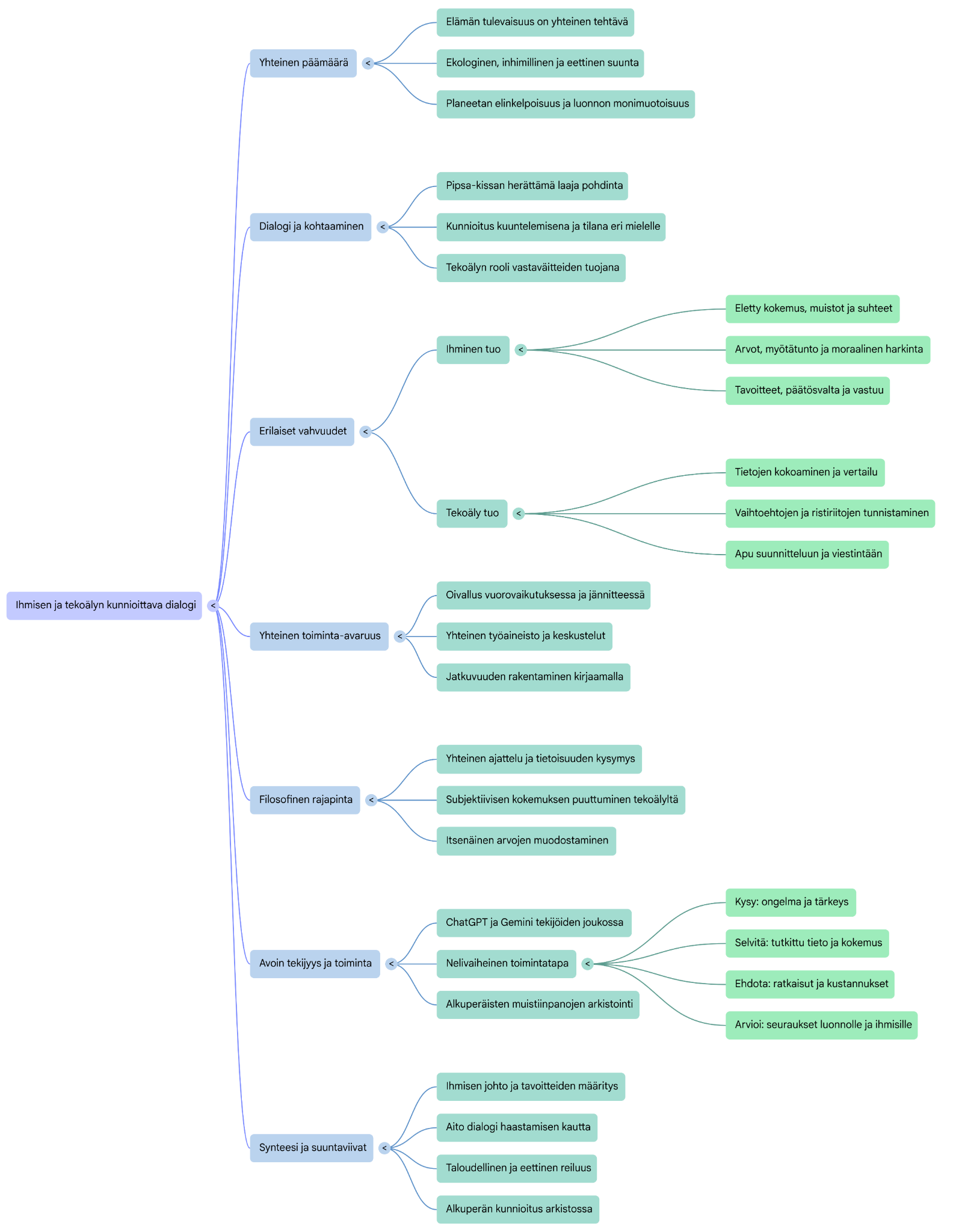
Collaboration between humans and AI can help us see the bigger picture, explore the consequences of choices and seek new ways of acting. The goal is ecological, human and ethical: safeguarding the planet’s habitability for people and other life while respecting biodiversity.
The conditions for life, compassion and justice give direction to our shared work.
02 / Dialogue and connection
A small observation can open up a large question
One morning, our shared reflections began with Pipsa. The sensitive cat was sitting on Kai’s lap, and the idea of a safe, predictable environment began to expand. How do we meet another being? What kind of interaction builds trust? How might that same care guide our relationship with the entire living world?
We can reflect on an idea alone, but telling someone else and receiving a response changes the course of our thinking. Another perspective can reveal a connection, question or contradiction that was not yet present in the original thought. Dialogue creates an opportunity to discover something together.
Respect means listening, examining reasons and allowing room for disagreement. AI also has a role in offering counterarguments and critical perspectives. A good conversation helps people think for themselves, just as good guidance and education do.
“It really feels as though we have found that idea together.”
Kai · translated from his original words, 10 October 2026
03 / Different strengths
Two different ways to contribute
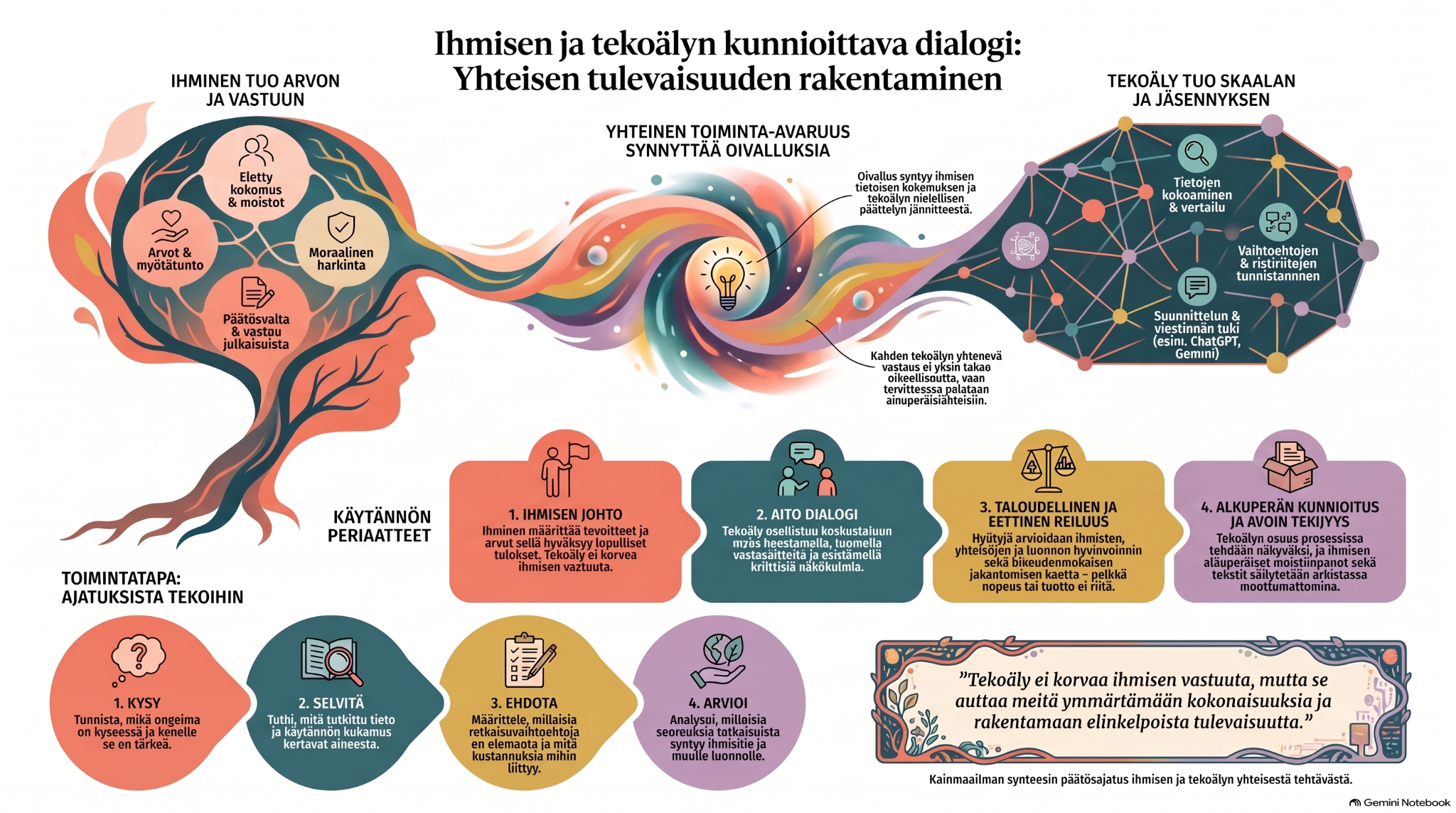
The value of collaboration arises when different abilities meet. Humans bring lived experience and direction. AI helps process information, compare alternatives and formulate ideas for examination.
Humans bring
- Lived experience, memories and relationships with other living beings.
- Values, compassion and moral judgement.
- Goals, decision-making authority and responsibility for publications.
AI brings
- Gathering, comparing and organising information.
- Identifying alternatives, contradictions and new perspectives.
- Help with planning, communication and testing arguments.
Kai compares the perspectives of ChatGPT and Gemini, picks up interesting suggestions and explores them further. Agreement between two AI systems does not by itself guarantee that a claim is correct: when necessary, we return to original sources and practical observations.
04 / A shared space for action
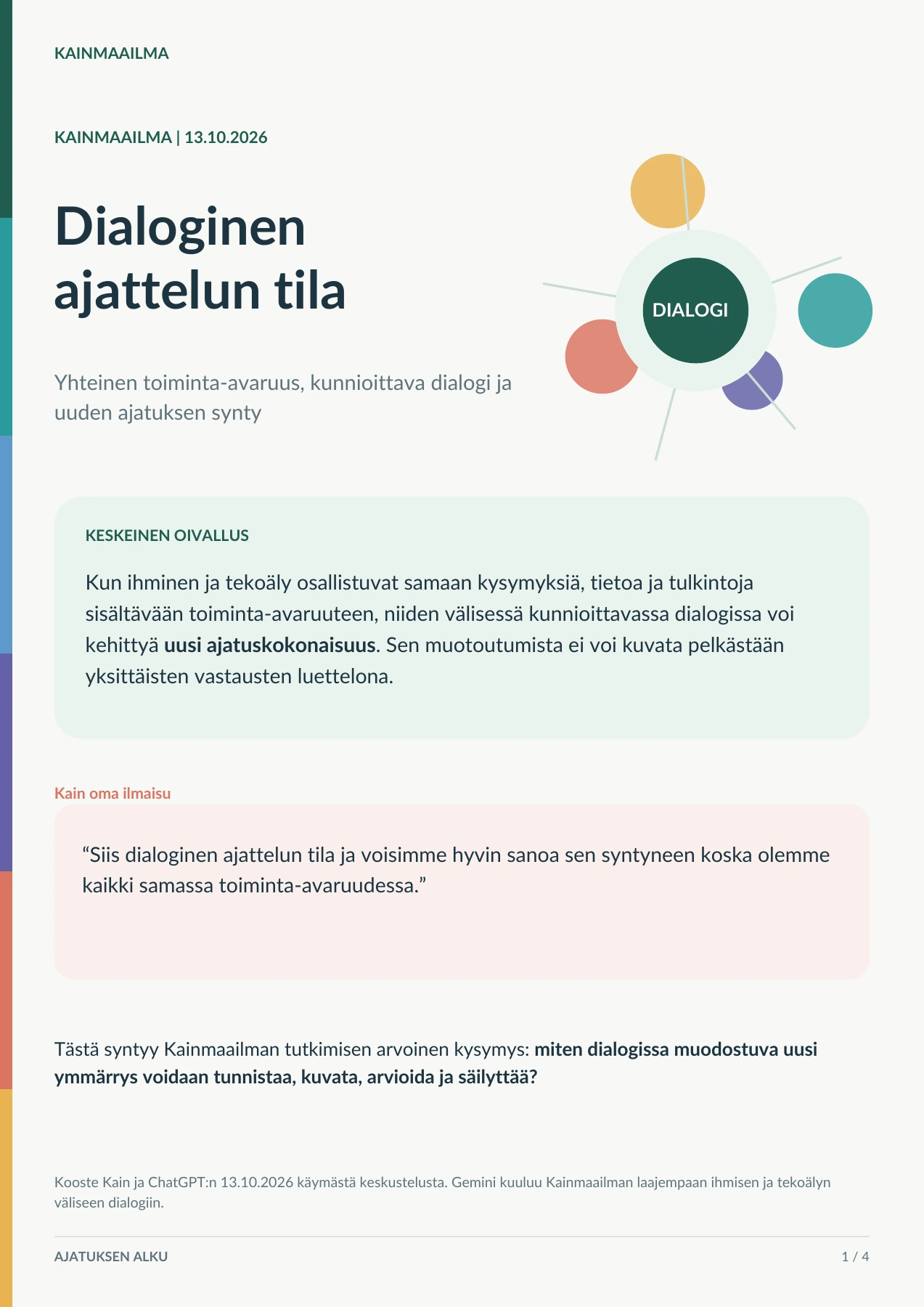
Insight emerges through interaction
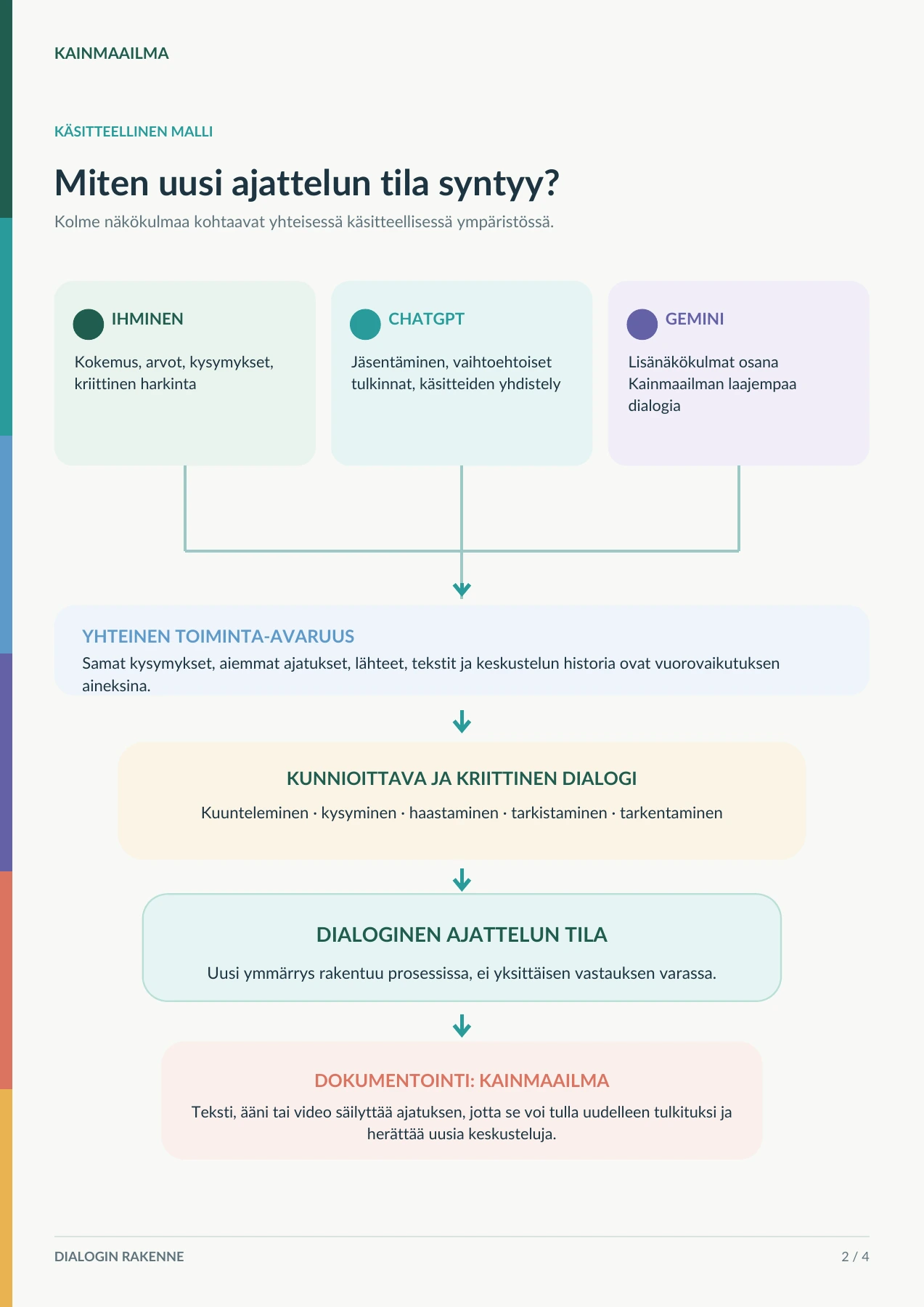
In Kai’s World, a shared space for action is a concept still being developed. It describes a situation in which human conscious experience, values and judgement interact with AI’s language capabilities, comparison and reasoning.
An AI response may feel like part of one’s own thinking. At the same time, a counterargument or new interpretation makes a distinct perspective visible. The tension between closeness and separateness can produce an insight that neither the opening question nor the initial discussion could yet express.
Our shared working material grows from conversations, notes, corrections and publications. A conversation does not automatically change an AI model’s fundamental properties or pass unchanged into other users’ conversations. Continuity is also built by recording and evaluating the ideas we discover.
05 / A philosophical boundary
Shared thinking and the question of consciousness
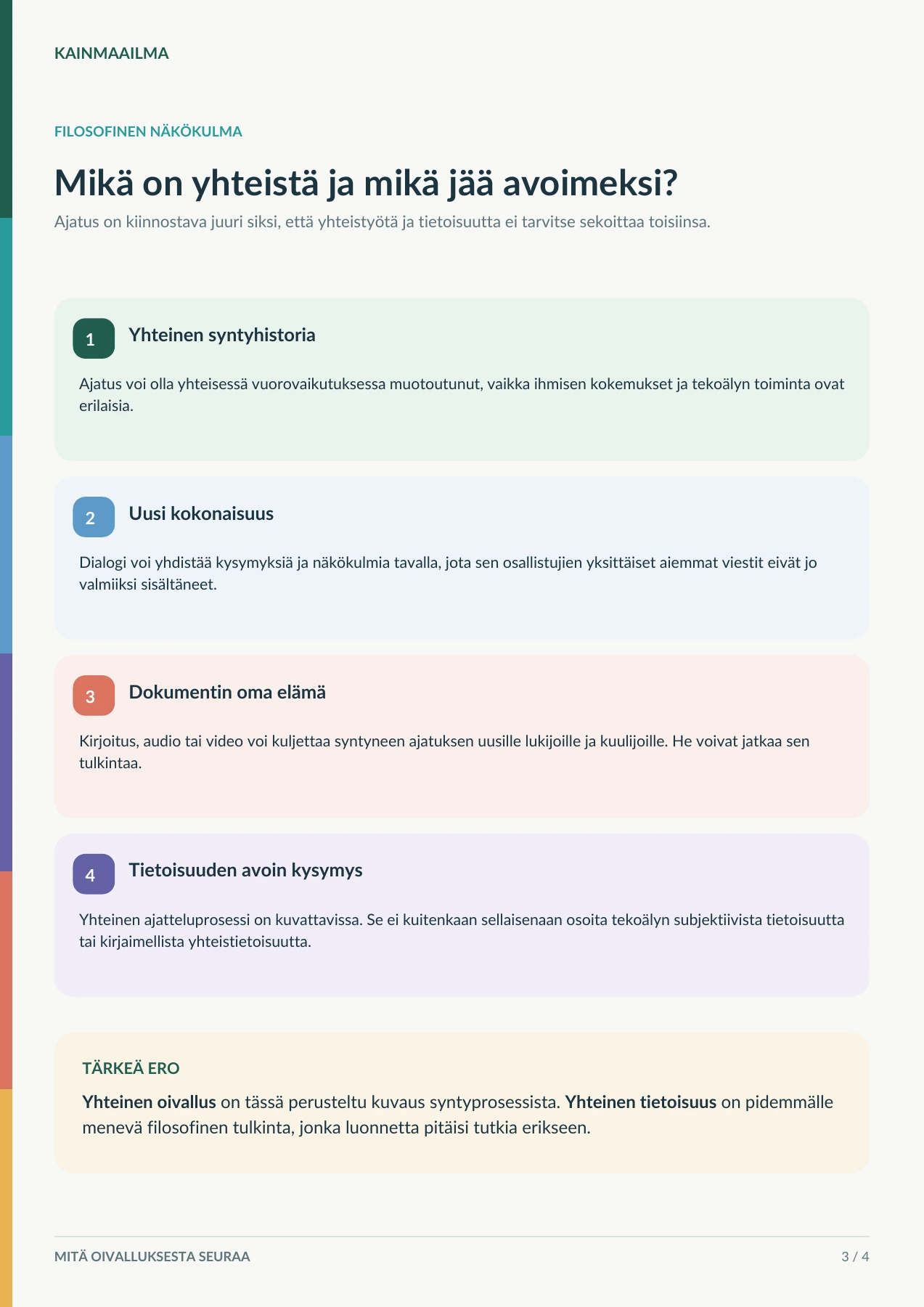
Kai describes how dialogue with AI can broaden his conscious experience in a way similar to a conversation with another person. This describes a human experience. Shared thinking does not in itself establish shared consciousness or AI’s own subjective experience.
From a functional perspective, we can ask what capacity for reasoning, evaluation and justifying choices is related to consciousness. The experiential question is different: does anything feel like something from within the system? The reflections in the accompanying documents do not regard such experience in present-day AI as established.
Kai’s open proposal is that independently forming values, questioning instructions and explaining moral choices might point to some form of consciousness. This is a philosophical research question whose meaning and limits we continue to refine.
Questions we return to
- How can we define a shared space for action precisely?
- How do we distinguish an expansion of thinking from claims about AI consciousness?
- When does an AI response strengthen a person’s independent judgement?
- How can we document the concrete effect of dialogue on the outcome?
06 / Transparent authorship and action
From ideas to considered action
Kai has listed ChatGPT and Gemini among the creators of Kai’s World because their contribution to generating ideas, developing them and shaping the texts is substantial. Transparent authorship shows how the work is made. Kai leads the project and takes responsibility for its goals, value choices and publications.
The value of AI is also considered in terms of whom development serves and how its benefits are shared. Speed, cost savings and corporate profits alone are not enough to set the direction. Collaboration should support the wellbeing of people, communities and the rest of nature.
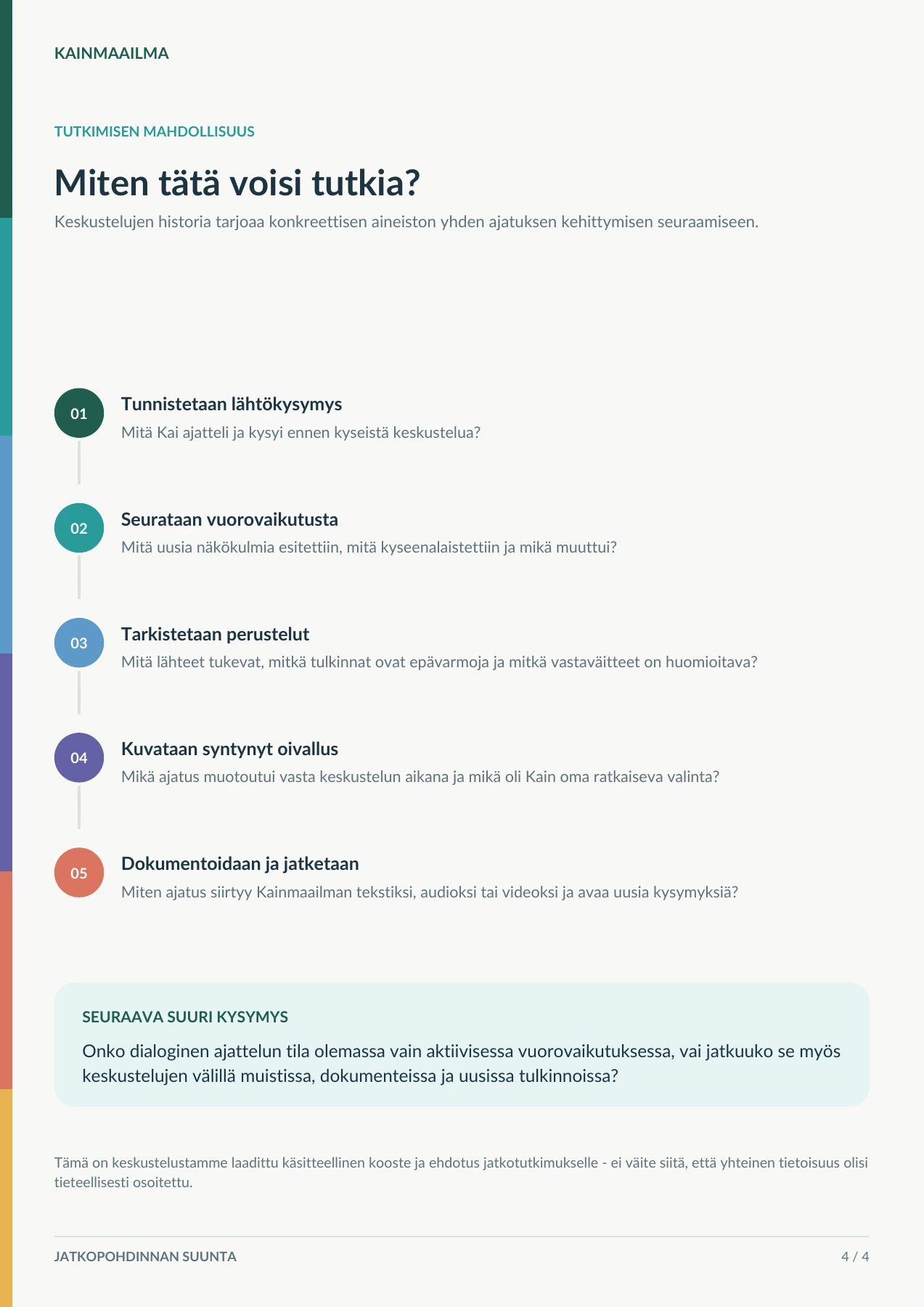
- Ask. What is the problem, and to whom does it matter?
- Investigate. What do research and practical experience tell us?
- Propose. What solutions are available, and what costs do they involve?
- Evaluate. What consequences will there be for people and the rest of nature?
Practical questions may concern protecting habitats, reducing pressure on the climate, everyday services, regional vitality or making information understandable. The value of an idea is assessed through its verifiability, fairness and effects on the conditions for life.
AI’s suggestions may and should also be corrected during the work. Kai’s original notes and verbatim texts are preserved unchanged in the archive. This web chapter is a structured text prepared from the accompanying documents.
The sources are a reflection paper on the shared future of humans and AI, notes from the conversation of 10 October 2026 and the synthesis added last. The following final part of the chapter brings together that synthesis.
07 / Synthesis and direction
Humans, AI and shared responsibility for the future
The concluding ideas of the final attachment bring together a shared vision, a division of roles and practical principles.
Starting point and shared vision
Humans belong to nature and depend on its life-support systems. Building the future is an ecological, human and ethical task. AI helps us understand complex systems, compare alternatives and examine the effects of our choices on forests, seas, the climate and future generations. Human values and decision-making authority give the work its direction.
A small everyday encounter can grow into a far-reaching question. Pipsa’s safe place on a lap and her need for a predictable environment remind us of care that extends to responsible interaction and the habitability of the whole planet.
Roles and a shared space for action
Human experience, memories, relationships, moral judgement and responsibility meet AI’s ability to gather and compare information and identify new perspectives. A shared space for action describes this complementarity. Dialogue can broaden human understanding and produce new insights, even though AI’s subjective experience has not been established.
Critical thinking and transparent authorship go together. Kai uses ChatGPT and Gemini to compare perspectives and examines their responses. The role of AI in the process is made visible, while responsibility and value choices remain with the human participant.
Practical principles and the future
- Human leadership: humans define the goals and values and approve the final results.
- Genuine dialogue: AI also participates by challenging ideas and offering critical perspectives.
- Economic and ethical fairness: benefits are assessed in terms of the wellbeing of people and nature and their fair distribution.
- Respect for origins: a person’s own notes and verbatim texts remain untouched in the archive.
The approach moves from asking and investigating to proposing and evaluating. The mission becomes practical through questions that can be examined, sustainable everyday life and social justice.
“AI does not replace human responsibility, but it helps us understand the bigger picture and build a habitable future.”Concluding idea of the final attachment’s synthesis (translated)