Nature is the foundation of all life
Nature is an absolute prerequisite for human life. Its wellbeing must come first, because health, food, security, society and the economy are built upon it.
We need breathable air, clean water, living soil and functioning ecosystems every day. Money is a human invention, but nature sustains our lives. If we destroy the conditions for living, no accumulated wealth can replace them.
Caring for nature must therefore underpin all decision-making. The purpose of the economy is to secure opportunities for a good life within nature’s carrying capacity. Economic activity that undermines this foundation also jeopardises its own future.
Humans belong to the diversity of life
Humans are part of nature and its web of relationships. Our lives depend on photosynthesis in plants, pollinators, soil organisms and the cycles of water and nutrients. This dependence remains even when we do not notice it in everyday life.
The importance of nature goes far deeper than beautiful landscapes and refreshing walks in the forest. It is about our very ability to live.
Other organisms also have value in their own right, regardless of their usefulness to humans. We do not inhabit the world alone, and our right to a good life does not justify destroying the conditions for others to live. Our responsibility extends to future human generations and to the whole diversity of life.
Historical change: from close dependence to distance
Close dependence on nature
Nature’s actual importance has not diminished throughout history. What has changed is how visibly our dependence on nature is present in everyday life and how much weight it is given in society’s decisions.
In hunter-gatherer communities, survival required detailed knowledge of the environment. Animal movements, the places where plants grew and the changing seasons were everyday knowledge. In many cultures, this dependence was expressed through respect for nature and an understanding of humanity’s place within the living whole.
Agriculture changes our relationship with the environment
Agriculture changed our relationship with the environment. People altered the land more intensively, but dependence on soil, water and weather remained tangible. Farming cleared natural habitats, yet long-term mowing and grazing also created diverse traditional habitats. Past relationships with nature were therefore neither uniform everywhere nor always harmonious.
Industrialisation increases the use of natural resources
Industrialisation expanded resource use to an entirely new scale. Machines and fossil energy enabled growth in production and material wellbeing. At the same time, nature increasingly came to be viewed as a store of raw materials and a source of economic gain.
Mass consumption distances the consequences from everyday life
With mass consumption, the consequences of production have become remote from many people’s everyday lives. We see the finished product, but not necessarily the land, water and energy it required or the damage it caused. This distance can create the illusion that our lives have become detached from nature.
Knowledge grows, but action does not change enough
Here lies a serious contradiction of our time: we understand the importance of nature ever better, yet this knowledge does not sufficiently guide our way of life, the economy or decision-making.
We recognise the value of biodiversity, but destroy habitats. We know that natural resources are finite, but continually seek greater material consumption. Degrading nature may appear profitable when its real costs are borne by other people, other living beings and future generations.
Knowledge becomes responsibility only when it is reflected in our choices. We must also assess wellbeing by whether life-support systems remain able to function.
The degradation of nature increases society’s vulnerability
The impoverishment of nature and society’s vulnerability are intertwined. Food production, water availability, health and security require functioning ecosystems.
Vulnerability also grows when vital functions depend on a few large units and long supply chains without viable alternatives. A disruption at one point can then have widespread effects.
The benefits of centralisation must therefore be assessed alongside its risks. Local expertise, diverse food production, nearby services and mutually supportive communities strengthen our ability to cope with difficulties. Caring for biodiversity belongs to this same foundation of security.
Changing direction is possible
The future is not predetermined. We can combine research, local experience and technology in a way of life that safeguards nature’s renewal.
This requires protecting and restoring habitats, reducing the overconsumption of natural resources and bringing production and consumption within ecological limits. At the same time, we need a society in which people can participate, care for their local environment and support one another.
The decisive question is: do today’s decisions preserve tomorrow’s opportunities for life?
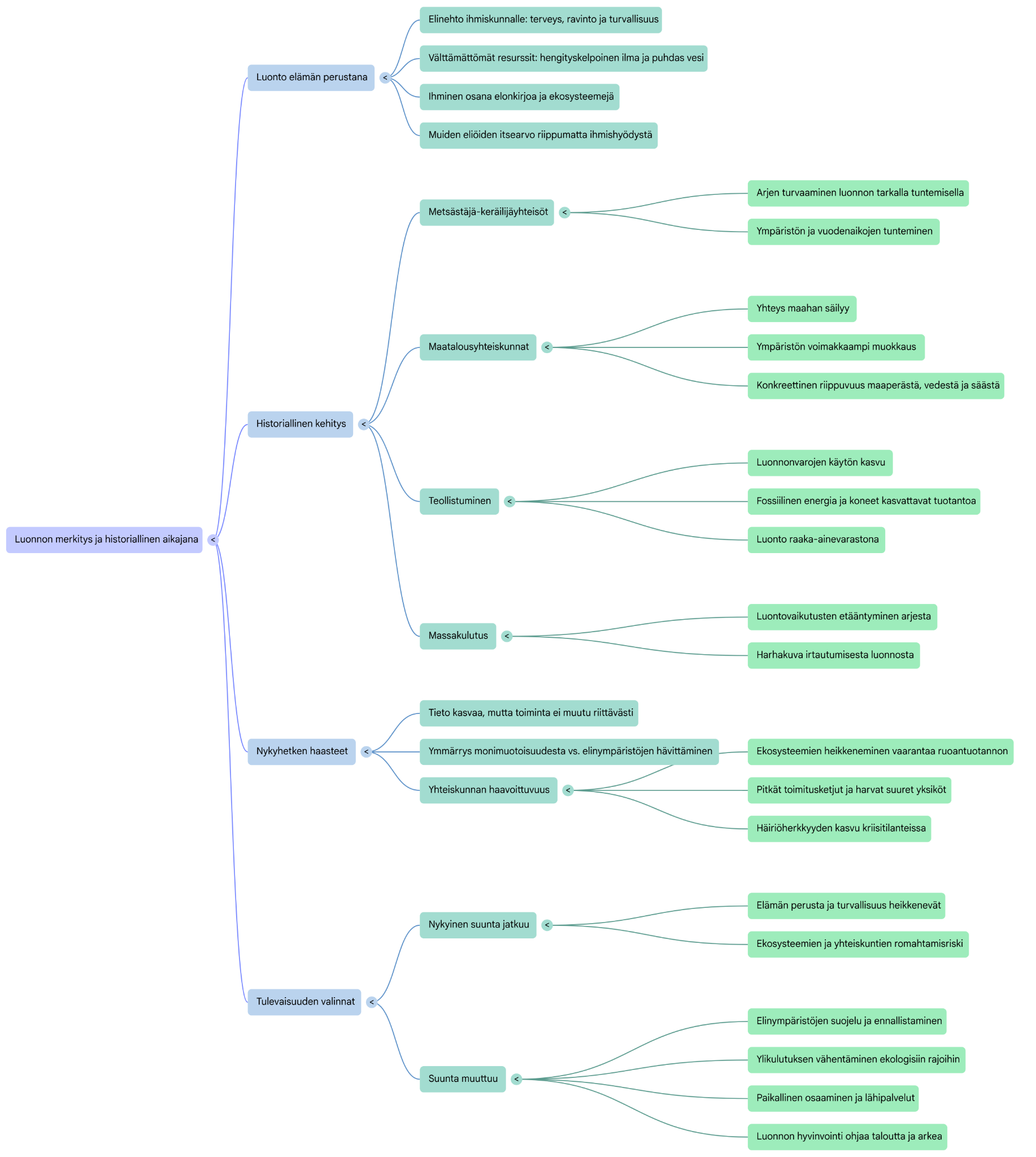
A historical timeline and the choice ahead
This timeline generalises developments particularly in industrialised societies. It does not place all cultures on the same path. Nature has been equally indispensable at every stage.
- Hunter-gatherer communities: Detailed knowledge of nature supports everyday life. Survival rests on knowing animals, plants, seasons and the environment.
- Agricultural societies: The connection to the land remains, but people alter their surroundings more intensively. Dependence on soil, water and weather remains tangible.
- Industrialisation: Machines and fossil energy increase production and resource use. Nature is increasingly viewed as a store of raw materials.
- Mass consumption: Production and consumption increase, but their impacts on nature become distant from everyday life. Land use, water and energy consumption and environmental harm remain hidden behind the finished product.
- The present: Knowledge of nature’s importance grows, but nature continues to decline. Understanding does not yet sufficiently guide consumption, the economy and decisions.
- The current direction continues: If nature’s degradation continues, the foundation of life and society’s security weaken. Food production, water availability, health and the ability of societies to function face increasing danger.
- We change direction: If nature’s wellbeing begins to guide the economy and everyday life, we can protect and restore habitats, reduce overconsumption and bring production and consumption within ecological limits.
The central choice in the timeline takes place now: we can continue to degrade nature, or change direction so that nature’s renewal and life-support systems become the basis of decision-making.
If we do not invest in nature’s wellbeing, we endanger the foundation of our own lives.
Food, clean water and a safe living environment become less available. Health risks and societies’ sensitivity to disruption increase, and future generations’ opportunities for a good life narrow. If life-supporting ecosystems collapse, the societies built upon them may also collapse. No amount of money can replace lost conditions for life.